smaller harvest, unprecedented export week
Despite a sharp drop in the Dutch seed-grown onion harvest, exports have reached a new high. More than 52,500 metric tons of Holland Onions left the country in a single week. Behind that remarkable record is a global onion market in constant motion.
A week for the record books
In week 42, the Netherlands exported more than 52,500 tons of onions, beating the previous weekly record of 47,082 tons, set in 2020, by roughly 12%. An exceptional result in a season marked by a smaller Dutch crop and concerns about how much of it will store well.
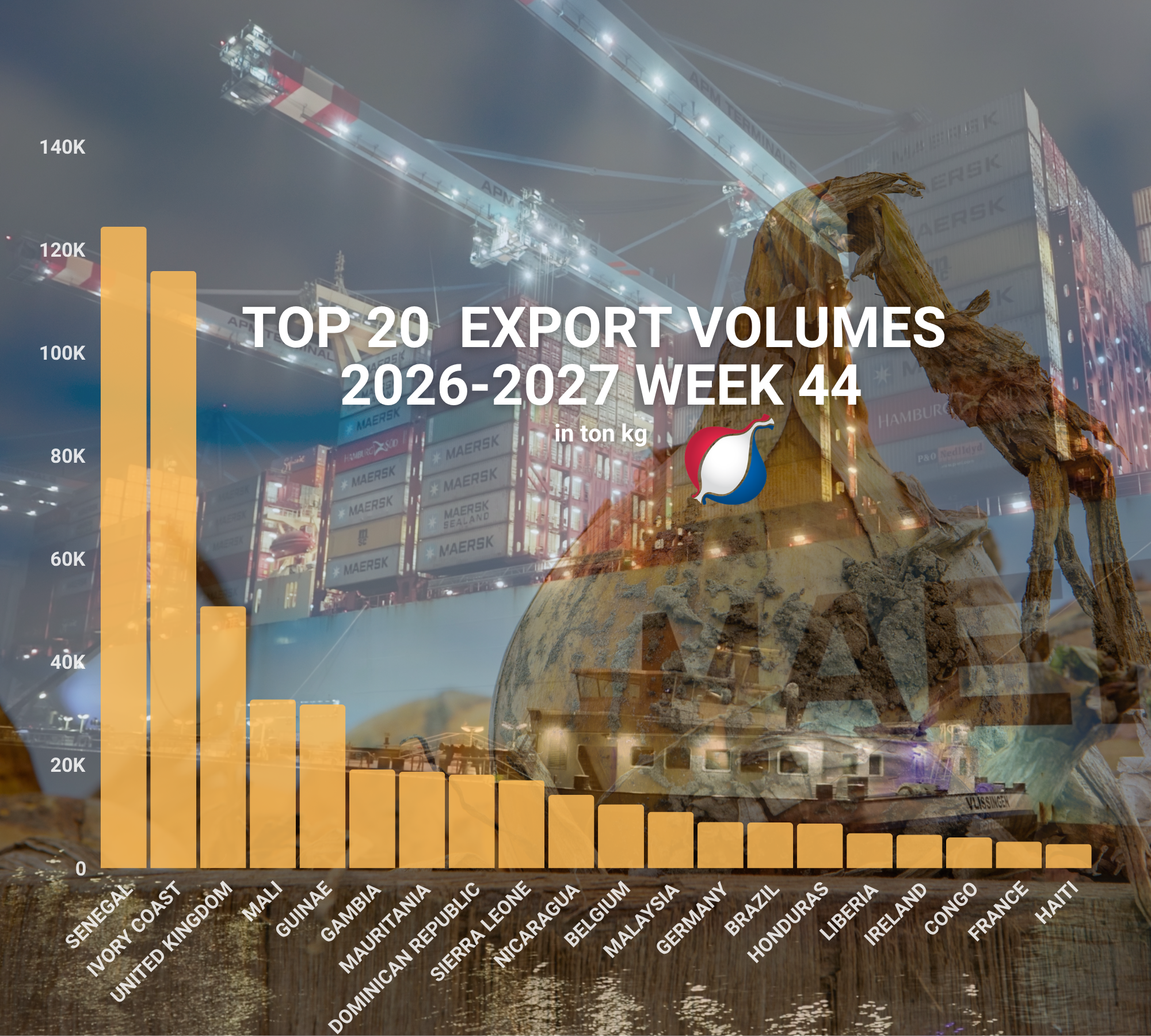
Where did those onions go? Senegal took 20,059 tons and Ivory Coast 7,525 tons, together accounting for more than half the week’s Dutch onion exports. Mali followed with 3,311 tons, ahead of Guinea and the United Kingdom. Weekly figures can fluctuate with shipping schedules, but the scale of this result speaks for itself.
Even more striking, this record came with onion prices far above last season’s. Low prices helped drive the previous export record, yet global demand remains strong even at today’s much higher prices. That speaks to the Holland Onion’s standing in world markets—and to the place onions hold in the daily diets of millions.
Exports in the 2026/27 season, which began in week 27, have now passed the half-million-ton mark. By the end of week 44, shipments totaled 585,822 tons, 3% ahead of last season’s pace.
The harvest tells a different story
Export strength contrasts sharply with the Dutch harvest forecast. Statistics Netherlands (CBS) puts this year’s gross seed-grown onion crop at about 1.55 million tons, down roughly 15% from 2025. Although total seed-grown onion acreage was virtually unchanged (−1%), average gross yield fell 14% to 45.7 tons per hectare. Yellow and red onions tell very different stories. Yellow onion acreage grew 2%, but production dropped 12%. Red onion acreage shrank 15%, and production fell 25%.
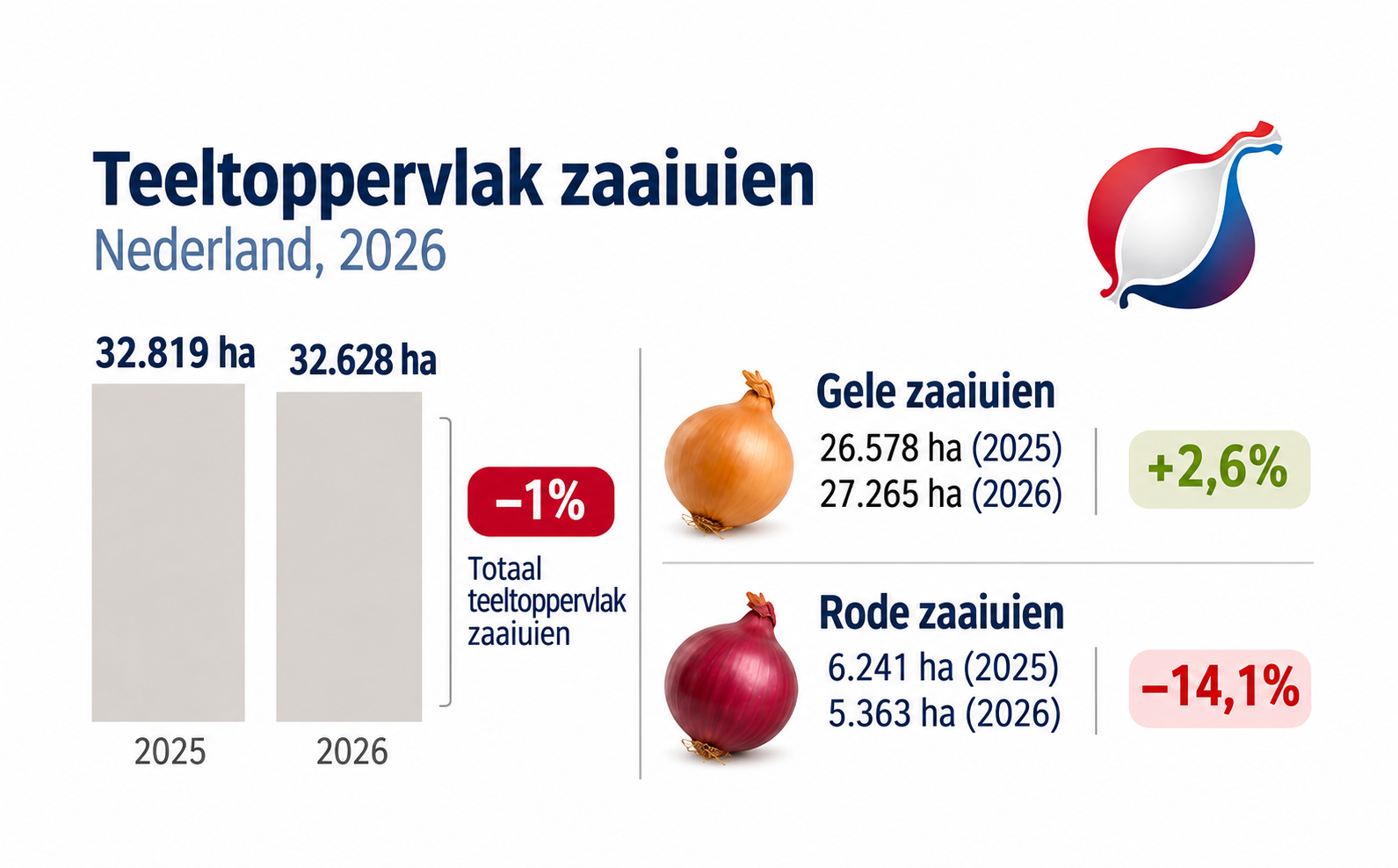
Source: CBS
But the figures need context. Onions grown from sets fared differently from those grown from seed. With planting area expanding to around 7,000 hectares, gross production of set-grown onions rose about 9%. These relatively large, early-season onions helped exports get off to a strong start. In the coming months, however, the later seed-grown crop will play a growing role.
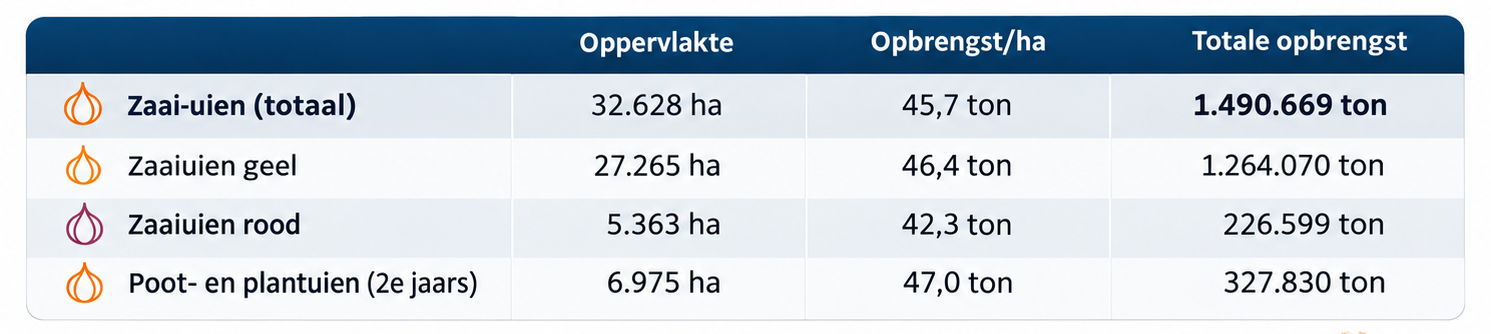
Source: CBS
Harvest volume is not the same as marketable volume. Drought and heat created wide variations between growing regions, and even between fields. Fusarium and bacterial rot may also affect grading losses and storage life. Ultimately, export availability depends not just on how many onions are harvested, but on the condition in which they enter storage.
Europe: a mixed harvest
Europe is also expecting a smaller crop. According to estimates from German market information service AMI, based on national statistics and data from countries participating in EURONION (October 26–28, 2026), combined onion production in the European Union and United Kingdom is forecast to fall from 7.39 million tons in 2025 to 6.88 million tons in 2026. That is a drop of nearly 7%, the first in four years.
That overall decline masks sharp differences. Production is expected to fall 11.6% in France, 7.7% in Germany, 9.2% in Poland and 10% in the United Kingdom. Spain (+5.4%) and Sweden (+11.9%) are moving in the opposite direction. Country presentations at EURONION in London also revealed differences in size distribution, quality and storage potential.
Germany expects a gross crop of around 833,500 tons, below last year’s record but not yet signaling a shortage. Regional differences are substantial. Larger grades and red onions are relatively scarce, while maintaining quality in storage remains a concern. Poland is more upbeat: despite less acreage, reports point to good yields and ample supplies of marketable onions.
Spain is another exception, with production forecast at about 1.21 million tons in 2026. France expects around 535,000 tons—too little to supply its domestic market year-round—and is also facing quality problems with red onions. The United Kingdom expects about 286,000 tons available in 2026 and remains heavily dependent on imports, especially as demand for larger sizes has surged.
West Africa: export flows remain in motion
Dutch export figures show why no region should be treated as a single market. Through week 44, Senegal remained the largest buyer with nearly 124,500 tons, up slightly above the same period last season. Ivory Coast follows with 116.000 tons, representing growth of 9.6%. The two leading markets are now separated by around 8,500 tons.
Elsewhere in West Africa, the contrasts are sharper. Guinea is down 3.7% and Mauritania 10.5%. Mali, well ahead at the start of the season, is now trailing by almost 6%. Meanwhile, shipments to Sierra Leone are up almost 46%, to Liberia nearly 99% and to Gambia 13.5%.
West African demand is not moving in one direction. Sales are shifting between destinations, and the Dutch export chain’s ability to respond quickly is a major strength. The challenge is distinguishing lasting market growth from a temporary sales opportunity.
Growth across the Atlantic
The same shifts are apparent in the Americas and Caribbean. Through week 44, the Dominican Republic imported 18,141 tons, up to almost 30%. Nicaragua took more than 14,200 tons, an increase of approximately 15%. Haiti and Guatemala also posted strong gains. In several markets, that growth means thousands of additional tons—not merely impressive percentages on small starting volumes.
Asia and the Middle East: mixed export trends
Export patterns across Asia and the Middle East are also changing. Malaysia bought 10,913 tons of Holland Onions through week 44, down 14.7% from last season. Israel took 3,987 tons, an increase of 165%. Sri Lanka bought 2,368 tons, compared with just 29 tons in the same period last season. Indonesia took 3,023 tons, compared with no recorded exports a year earlier. Singapore also grew, though on a smaller scale, from 198 to 328 tons.
But gains are far from universal. Shipments to Japan fell from as did Vietnam. Volumes remain well below those of the main West African markets, but the differences from country to country show how quickly export demand can shift.
Europe falls behind
Against this momentum outside Europe, several European destinations are conspicuously weak. Exports to Belgium are down 19%, France 35% and Spain 66.0%. Shipments to Portugal have all but stopped compared with this point last season, while Sweden, Finland and Italy have also seen steep declines. These are not just eye-catching percentages: together, they represent substantial volumes.
Spain’s larger domestic crop may help explain the drop, but harvest size is only part of the story. Stocks, size grades, price differences and import timing also matter. The United Kingdom and Ireland are a notably stable exception. At nearly 51,000 tons to the UK, shipments are just 2.6% below last season’s already exceptional level.
The real test lies ahead
One record week does not define a full export season. The coming months will reveal how much of the Dutch crop remains available after grading, storage and possible quality losses. Export opportunities will also change as other producing countries market their harvests and import windows open or close.
The Holland Onion Association estimates that around 1.21 million tons of Dutch onions will be available for net export this season.